Two Minds, One Vision: The Creative Partnerships That Are Quietly Rewriting the Rules
The Myth We Keep Telling Ourselves
We love a single name on the marquee. We love the image of the tortured artist alone in a room, pulling something brilliant from the void. It's a clean story. It gives us someone to admire, someone to credit, someone to follow. The solo genius is a cultural archetype so deeply embedded in how we talk about creativity that questioning it almost feels sacrilegious.
But here's the thing: it's mostly fiction.
Not entirely — there are genuinely singular creative voices doing work that couldn't exist any other way. But the dominance of the solo creator narrative has obscured something that's been true for a long time and is becoming more visible by the day: the most durable, innovative, and emotionally resonant work tends to come from people making things together.
What Chemistry Actually Does
The word "chemistry" gets thrown around a lot when we talk about creative partnerships, but it's worth unpacking what it actually means in practice. It's not just vibes. It's a specific dynamic where two people's instincts complement rather than replicate each other — where one person's strength is exactly what the other person's weakness needs.
Think about the writing partnership of Tina Fey and Robert Carlock on "30 Rock" — a show that was too weird, too fast, and too dense to have come from a single sensibility trying to please a broad audience. Or look at how Beyoncé's most acclaimed work has consistently involved deep collaboration with producers, co-writers, and creative directors, even when the final product feels profoundly personal. The collaboration doesn't dilute the vision. It pressure-tests it, pushes it further, makes it structurally stronger.
In music, the partnership between Jack Antonoff and a rotating cast of major artists — Taylor Swift, Lorde, Lana Del Rey — has produced a body of work that's harder to explain than it looks. Antonoff's production sensibility meets each artist's voice in a way that doesn't flatten either of them. That's not a coincidence. That's what genuine creative partnership looks like when it's working.
The Accountability Factor Nobody Talks About
Here's an underrated benefit of working with someone else: you can't disappear into your own head as easily.
Solo creators — especially in the current media landscape, where burnout is epidemic and the pressure to produce is relentless — often describe a particular kind of paralysis. There's no one to check in with, no one to notice when you've been staring at the same draft for six weeks, no one to say "this is good, ship it" or "this isn't landing, let's figure out why."
Creative partners provide a built-in feedback loop that's qualitatively different from audience feedback or even editorial feedback. It's real-time, it's deeply context-aware, and it's rooted in mutual investment in the work. When someone has their fingerprints on what you're making, they care about it the way you care about it.
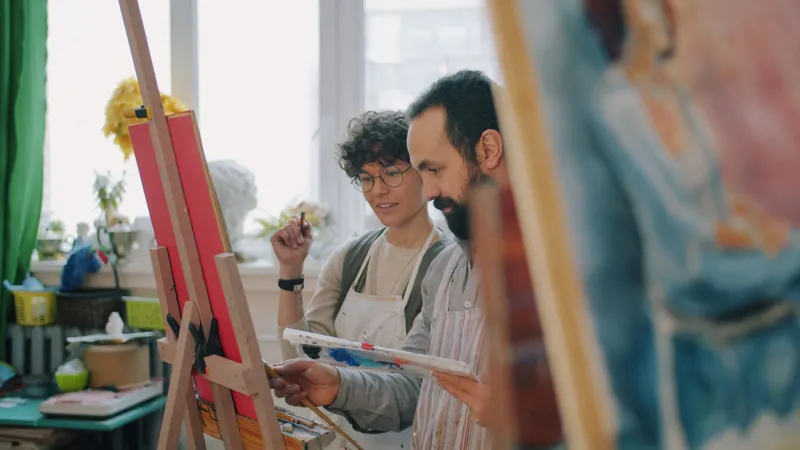
This also applies to small collectives and ensemble creative groups. The podcast duo, the two-person writing room, the art collective operating out of a shared studio — these structures create accountability that sustains output in ways solo creators often struggle to replicate.
When the Sum Is Actually Greater
There's a specific kind of creative output that only emerges from genuine collaboration, and audiences feel the difference even if they can't name it. It has a texture that's hard to fake — a kind of productive tension baked into the work itself, where you can sense two (or more) perspectives negotiating, pushing, and sometimes pulling in slightly different directions.
The Coen Brothers are maybe the clearest example in American cinema. Joel and Ethan have been making films together so long that it's genuinely impossible to separate their individual contributions — and that's exactly the point. "No Country for Old Men," "Fargo," "The Big Lebowski" — these films have an internal logic and a tonal consistency that feels singular, but it was produced by two people who've spent decades learning to think together.
In the creator economy, smaller-scale versions of this are emerging all the time. YouTube channels co-hosted by longtime friends who have a genuine shorthand. Substack collaborations where two writers with different areas of expertise produce something neither could write alone. The audience can feel the realness of the relationship, and that realness becomes part of what they're subscribing to.
The Tension That Makes It Work
Not all creative partnerships are smooth. In fact, the ones that produce the most interesting work are often the ones with the most friction — not destructive conflict, but genuine creative disagreement that forces both parties to articulate and defend their instincts.
When a solo creator makes a choice, they can rationalize it privately and move on. When two creators make a choice together, someone has to actually explain why. That explanation process — the act of making implicit aesthetic instincts explicit — is where a lot of the real creative work happens.
It's also, not coincidentally, where the work gets more interesting. The compromise between two strong points of view is rarely a watered-down middle ground. More often, it's something neither person would've arrived at independently.
What This Means for the Audience
For fans and audiences, creative partnerships offer something the solo creator format doesn't: the pleasure of watching a relationship as much as a body of work. When you follow a creative duo or ensemble over time, you start to develop a feel for their dynamic — who pushes toward experimentation, who anchors things in craft, how they negotiate their differences in real time.
That relational layer adds depth to the fan experience. You're not just consuming the work; you're reading the chemistry behind it. And when that chemistry is real, it's one of the most compelling things in entertainment.
The solo genius myth isn't going away. But the evidence is piling up that the most interesting things happening right now are being made by people who figured out they were better together.